Tuesday, January 28, 2014

Using Task Cards as a Whole Class Review

At one point or another, I think we have all played Jeopardy with our classes.  It's fun, the kids love it, and it's an easy way to review!  I always struggle with keeping all of the kids engaged, and we needed to do a review of fraction operations and skills, so I threw together my own version of the game using some of my task cards.

I was on the hunt for a pocket chart, and one of my sweet colleagues had one that was MADE for this kind of thing.  It is only $4 on Amazon HERE.  I didn't need the question cards it came with, but it's perfect for the size of my quarter page task cards.

 
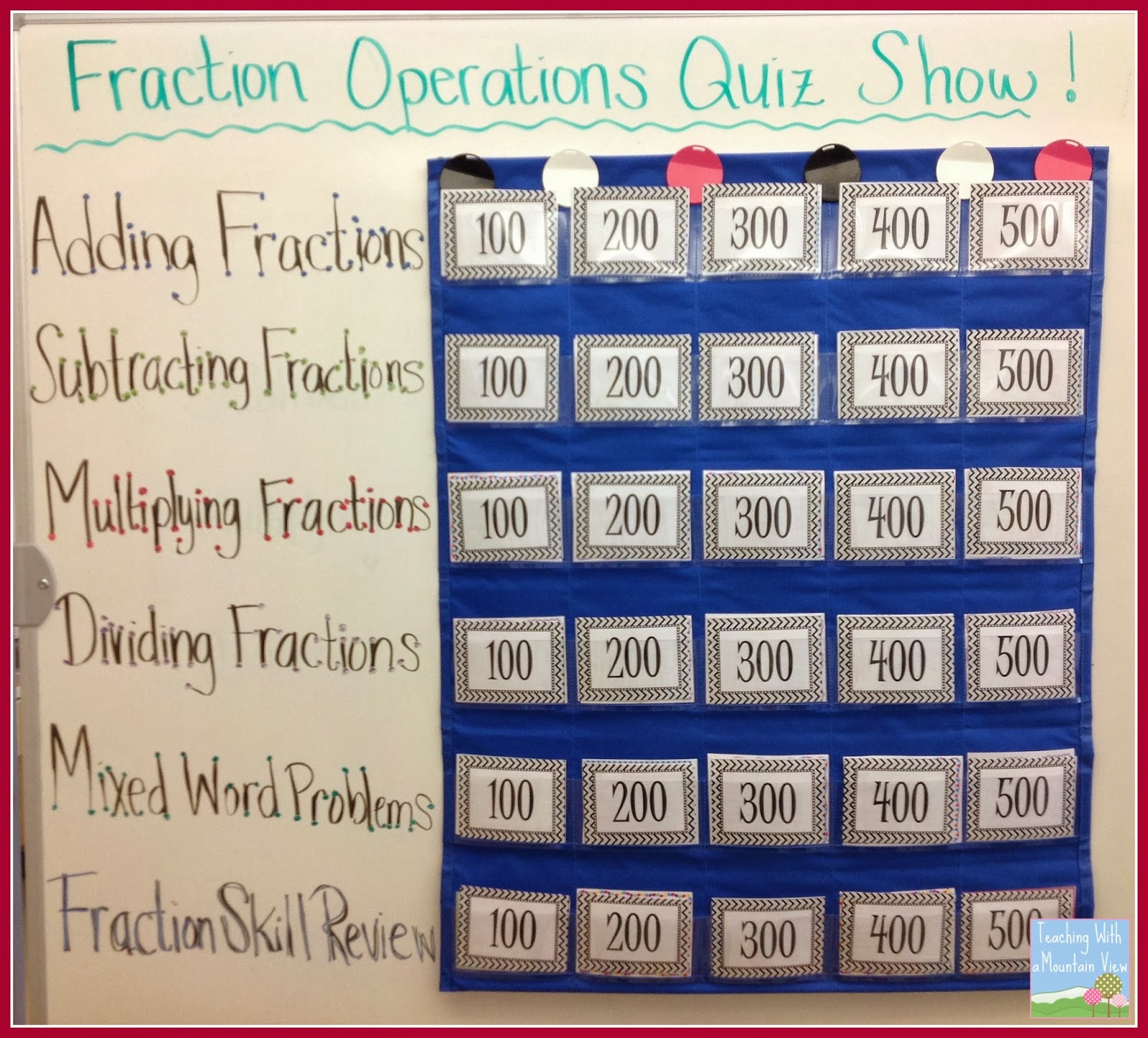
I set up the game board to include a wide variety of fraction problems including all of the operations, mixed skill review (comparing, simplifying, mixed numbers, etc.) and word problems.  I put a task card in each slot, with increasing difficulty and level of critical thinking needed to answer the problem. I covered each card with a point value ranging from 100-500.
 
Here is a look at my board...
 
Here is a look at the board before I put the point value cards on top.


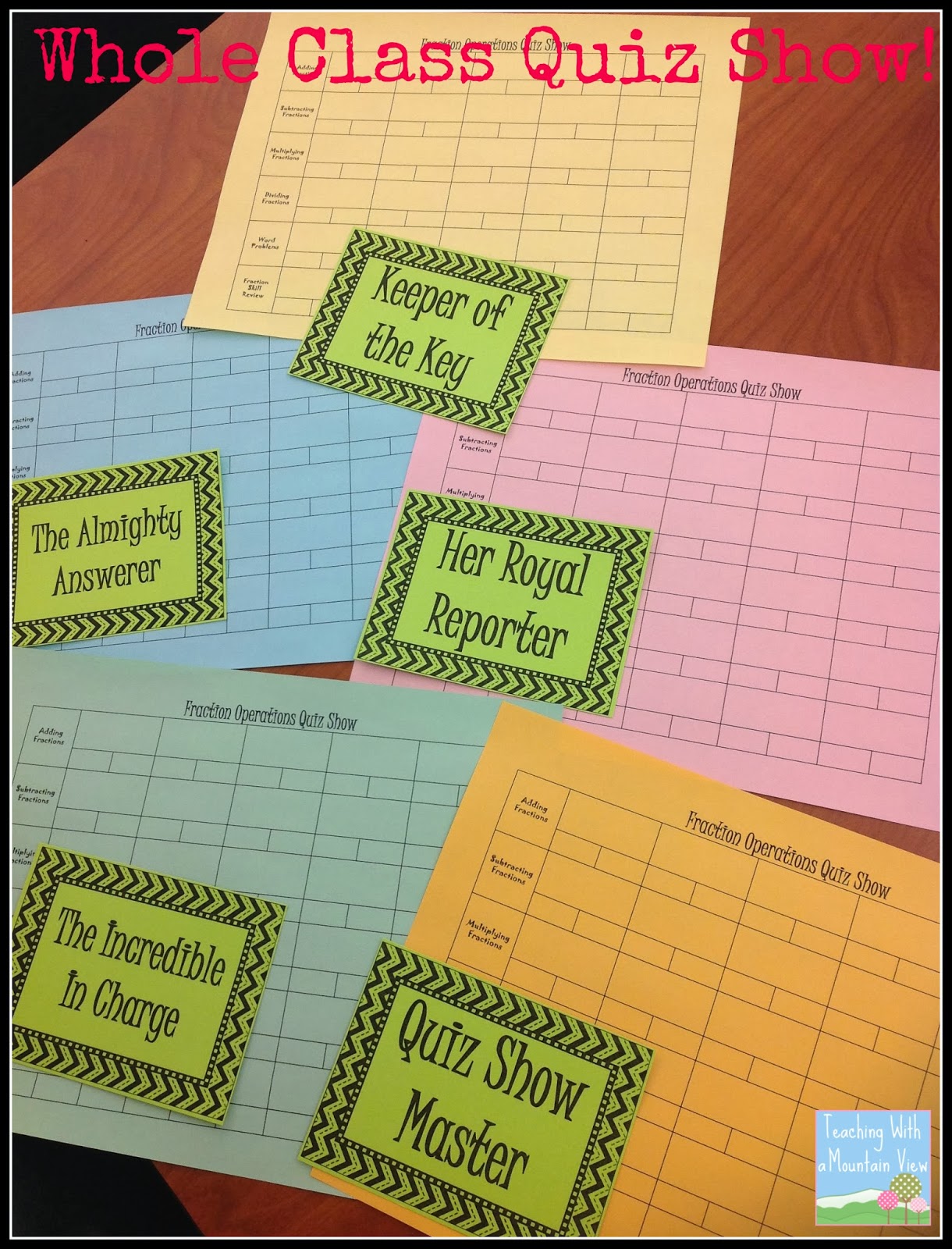
I knew I needed a way to make sure everyone was involved in the game and that each group wasn't only as strong as its strongest member and vice versa.  So, I changed things up a little bit.  Each group of students (I had 5 groups) had a silly card (named so by my students).  This silly card rotated through the group each round, and whoever had the card was in charge of reporting out their answer, and being able to explain how they arrived at their answer.  The group had to work together to solve the problem, but only the person with the card could go up and present the answer.

 
I got a little goofy with their titles, but they thought they were hilarious and lauged at me a little bit. :)
 
I also made a recording sheet that mirrored the gameboard.  Underneath each answer space was a smaller space divided in two sections.  In one section, they had to initial who was in charge of the answer, and on the right side they recorded their points.
 

I also kept them all engaged by giving each group a chance to get points each round, regardless of whether or not they were first done with the answer.  This was also me being sneaky and adding in some more multiplying fractions, and it worked!  More about the points later...

I started by selecting the first category and value and then the winner of each round got to select it from that point on.  I did a 3,2,1 countdown and put the task card on the document camera for the students to read and solve themselves.
Here's a look at one of the cards being projected up on the white board.  You can see the others we had already done underneath this one.

When the reporter and the group had solved the problem, they wrote their answer on their answer sheet.  The reporter had to walk (not run, slide, jump, or dive) up to the board and stand on one of five spots.  The first person to be done stood on spot one, second on spot two, and so on and so on.  I loved this part because it got them up and moving, and different combinations of kids were at the front each time.


A star on my (very dirty) carpet for a representative from each group to stand on when they finished the card.


I also wanted to keep the kids guessing about who was going to have to present their answer (again, I wanted EVERYONE to have a full understanding of the problem we were working on).  So, I put the numbers 1-5 in a jar and once I had a representative from each of the five groups standing on a spot, I drew a number and the person standing on that star had to share their answer and how they arrived at their answer.
 
 
I was a little worried the process might take too long, but they did great with it. It was also valuable for the students to hear other explanations for solving the problem, and the kids who got the answers wrong were able to very quickly figure out what they had done wrong.


I mentioned before that each group could get points each round if their answer was correct.  Here is how we did that.  If the student standing on star 1 (meaning they got the answer done and up to the board first) got it correct, they got the full value of the points.  If the person standing on star 2 got it correct, their group got 4/5 of the points for that card, and so on. 
 
Not only did they have to do more multiplying fractions, this helped me to emphasize that, no matter what, accuracy was more important than speed.  It was better to be the 5th group done and get 1/5 of the points than to be the 1st group done and get it wrong and get no points.  As I mentioned above, they kept track of their points on their sheet, directly under the problem they were solving. 
 
 
We are finishing up the game tomorrow, when they will add up all of their points, and we will see who was the winner for each category and also for the whole game.  The kids absolutely adored playing this, and I think they appreciated the few little twists I put on it to get everyone involved and to get the kids up and moving (we also rotated seats throughout the course of the game so that nobody had an unfair proximity advantage).  Of course, it's not fail proof, but the kids were engaged and practicing their math.
 
This picture cracks me up because I could not get a picture of the kids working that didn't have a blurry hand or pencil it in.  They were working like pros on these problems!


You can truly do this game with any concept, any set of task cards, or even create your own problems, but we happened to be reviewing fractions.  Here are the task cards I used in each section.  They are differentiated so that there are cards appropriate for values 100-500.
 
 
You can download the number cards and the recording sheet I used HERE.  It's nothing fancy because I wanted the students to have plenty of room to do their recording.  The frames for the numbers are from Pink Cat Studio.  Love her cute frames and borders!
 
If you're looking for a standard review for operations with fractions, you can download my FREE quiz or review from my TpT store.  I used this last year with great results!  Download it HERE.
 
 
Tuesday, January 21, 2014

Two New Ideas for Using Task Cards!

Is your task card collection growing?  Mine seems to grow every week, and I'm always looking for new, fun ways to use the cards with my students.  They love task cards no matter the format, but the more fun and exciting I can make them, the better.

Last week, as we were reviewing percentages, we did a little scavenger hunt.  There were 32 cards, which all had either a whole number answer, decimal answer, or percent answer.  I separated the cards into three different areas and hung them on a wall with a label to show the type of answer the card had.


Then, I used the answer key to write each answer on a separate sticky note.  I gave each of the students a sticky note and instructed them to put their sticky note above ANY card in the hallway, as long as it was in the correct section (i.e. if their answer was a percent, it had to go above a card in the percent section). 


Once every card had an answer above it, the students chose a starting card and went to work.  When they solved the card, they had to find the sticky note with their answer on it and then complete the card below it.  (I also had them put their numbers in order from least to greatest, but that was just a little something extra, and another way to make it easier for them to find their next card when they found their answer.)

You can do this with virtually any math task cards, and it's a great way to self-check!  The kids loved going from card to card and then figuring out where they needed to go next.  Bonus: They were up and moving the entire class instead of sitting at their desks!

If you are looking for a pre-made version of a scavenger hunt, I have also used Jason's at The PowerPoint Maniac.  He has some really interesting math scavenger hunts...the aren't identical to this format, but my kids love being detectives and looking through clues!  You can check them out at his TpT store HERE.

One of my TpT/Blogging Friends, Blair Turner, sent me a picture of my task cards in action in a room at her school. Blair blogs at One Lesson at a Time, and she has some incredibly brilliant interactive notebook resources!  She was in a classroom using some of my fraction task cards, and this teacher had a FABULOUS idea!


The teacher, Laura, had printed the task cards and added them individually to several large pieces of chart paper.  Each group of students got a piece of chart paper and some time to complete their cards.  Then, the groups traveled to two other charts, checked the work, and flagged them with sticky notes if they disagreed with an answer.  After checking the two other charts, the original group came back tot heir poster and made any corrections to the "flagged" cards.  I'm in love with this idea, and I can't wait to try it in the next couple of weeks!

Do you have a great idea for utilizing task cards?  I will offer a free set of cards from my store for any teacher who sends me picture of their task cards in action with a description of how they are being used!  I just love seeing other ideas from across the country.

Interested in more math task cards?  Click the image below!


Tuesday, December 3, 2013

Winter Early Finisher Task Cards!

Happy Holidays!

I'm popping in quickly to give you a peek at my Winter/Holiday Early Finisher Task Card Set Up!  I finished it tonight, and had to hang it up by the mantle and get all sorts of silly when I posted that they were "hung by the chimney with care."  It's late.  I'm tired.  Things get a little silly around here when 11  o'clock rolls around!


I even made a mini-set of some of my cards to give to a student in another class (who I consult with for enrichment services).  He put them in his early finisher binder with a new festive recording sheet.


Mini Task Cards!
You can download the free Winter Early Finisher Winter Work Log by clicking on the image and printing it!


Here is a look at the cards that I included on my Early Finisher Task Card display for the holidays!  There is even a freebie includes!

Christmas Carol Math & LA Task Cards
These are some of my students' favorites!  There are 8 task cards to go with several different beloved Christmas Carols, each with a few tasks for the students to complete.  They love, love, love these!


Holiday Fluency Task Cards
 I love using fluency task cards with my students.  I use them all throughout the year, so I thought it would be fun to change it up a little bit and throw in some Christmas ones!  I blogged about how I use my regular fluency task cards HERE.

Holiday Reading Skills Task Cards

Click here to view 
I have several sets of these reading skills task cards that we are going to be using for the next few weeks.  I left a few of each set out to use as early finisher assignments!  What's better than reviewing key reading skills with a holiday theme?

FREE Simile & Metaphor Task Cards!
My students ALWAYS need review on similes and metaphors, so these sweet cards were born!  I am offering them to you FREE as a little gift to you and your students.  Grab them now!


Winter Early Finisher Task Cards
 These cards are part of my Winter Early Finisher Task Card set.  The set includes 16 Writing Prompts, 16 Reading Skills Tasks, and 16 Math tasks.  All with a fun winter theme!


December Reading Skills Task Cards
These enrichment cards came from my December Reading Skills Task Cards set!  My students really enjoy completing these each month, and I love that it helps them review reading skills all the time.  Such fun!


You can download my title sign as well!  Just click on the image and print.

Thanks to Krista at Creative Clips for the adorable clip art!

Wednesday, October 2, 2013

Task Card Acronym

I have a lot of teachers in my school and in the blogging world ask me about task cards.  How do I use them?  What are they good for?  Why task cards instead of worksheets? Do kids like them? How often do you use them?  Obviously, I'm a huge proponent of their use in classrooms, for all of the reasons I have mentioned on this blog so far.  Task cards are awesome for differentiation, sub plans, reading response, for early finishers, for playing SCOOT, and for test prep.  But they are also a great resource for getting kids up and actively thinking, they are awesome for assessment, and they keep kids engaged (trust me on this one)!

I wanted something that I could use to show people a quick overview of not only how I use task cards, but also why I love them and invest my time in creating them and using them in my class.  So, I came up with this goofy little task card acronym.


I will be devoting an entire blog post to each of these subjects (if I haven't already), but I wanted to share this now since I think it's easy to understand and might spark an idea for you and all the task cards you have or are planning to have.   Stay tuned for some more task card inspiration, and in the meantime, take a look around Task Card Corner for more ideas on how best you can enhance your teaching with task cards!  


Saturday, August 31, 2013

Using Task Cards for Reading Response

I have always been a big believer in having kids respond to reading--thoughtful, defensible, evidence-based responses.  When I taught 3rd grade, I created reading response packets and novel studies for almost every book we were reading.  These were great because students would stop after each chapter and answer a variety of questions.  However, when I would turn the tables on them and ask them to write a question to accompany their reading, it was very hard for them to think beyond the literal questions and dig a little bit deeper.  Beyond that, when I had small groups reading shorter, leveled books for intentional skill work, I felt like I needed some good, solid questions to use for discussion.  Ideally, I wanted to be able to use these freely, with any book I chose, and with any group I was working with.  That's when I created a set of open-ended reading response cards on large index cards.  These were different, though, because they had blanks that students would need to fill in based on the book they were reading.


I blogged about these cards on my other blog, Teaching With a Mountain View, and when I did that, I typed them up so that I could share them (You can get them FREE here!).

I use these ALL the time.  They sit in my guided reading basket, and sometimes I even pull them out after I finish a read aloud for the day.  I love to see where student thinking is with these!  They are also great for getting students to start asking their own questions about reading in a more guided format. I don't even require that students write down their responses every time, especially in small groups.  I will give each of the students in a small group a card, and they generate the question and their answer all in their head and then share out.  Love doing this as a quick check!


I also use task cards for pre-reading activities!  I will give each student one of twelve pre-reading task cards (You can get them FREE here!) before we start reading and have them each work through it.  Most of them are made to only take 5 minutes or less, so then the students share out their card and their response to the card, and as a class, we have completed a comprehensive pre-reading activity!


Last year, we used both of these cards so much that I knew I needed something different, and I knew that I needed something that aligned closely with the Common Core and with the skills we were working on. There are a lot of reading response prompts out there (and some are excellent), but I needed something that would really push my students to think.  I needed to create something that the students would read, sit back and think about, and then read again before being able to answer the questions.

At the time, we were looking closely at story elements, so I decided to create the set to support that skill.  Again, I wanted a set that I could use over and over again so that students could really see some common themes in books.


This set has cards for Problem & Solution, Characters, Setting, and Theme
Later in the year, I made another set that focused on specific reading skills we were working on.  I so wished I would have made these YEARS ago!  These task cards have different prompts for skills like inferring, cause & effect, sequencing, etc.  I am already looking forward to using these again this year with some TAG 3rd graders who I will be supporting once a week outside of the classroom and then students all the way up to my 5th graders.  It's the perfect way to extend their thinking and not necesarily isolate these ever-important reading skills.


This set has cards for Fact & Opinion, Author's Purpose, Main Idea, Point of View, Compare & Contrast, Inference, and Cause & Effect
I really wanted my students to be able to access these cards easily, so I actually ended up making each student their own set of mini task cards to keep in their binders.  Now, I can give them some guided choice in their responses and it's FAST! Last week, after talking about inference, I said "Everyone select an inference response task card and write your response in your reading journal."  They all grabbed their set and went to work.  It was fabulous!


6 pages condensed into one 1.5.  This is a great way to save on ink and paper, too!
Easy peasy to print a mini set!

Here is a comparison of how much smaller the cards are than a regular quarter page task card.
I also have two other sets of Reading Skills Task Cards that I can vouch for because they are WONDERFUL:

Common Core Reading Response Task Cards (4th Grade) by Laura Love to Teach

If you have a set that you have used or made, feel free to link to them in the comments section of this post.  I am ALWAYS looking for new and fresh ways for my students to respond to reading!

NEW:  Here is the link to the website I used to order my chains.  They came very quickly, and they are just about as cheap as I could find them!

http://www.fitnessfinders.net/Four-Inch-Beaded-Chains-p/116-fourinchchains.htm?1=1&CartID=0


Sunday, July 28, 2013

Early Finisher Task Cards : Beyond Busy Work!

My first year of teaching, late one Friday night while working on plans for the next week, I told my barking dog to "SIT DOWN AND READ A BOOK."  This is not a joke, a lie, nor an exaggeration.  It actually came out of my mouth.  In that moment, I realized that my early finishers had one option: "sit down and read a book."  I went straight to the teacher supply store the next day and got a few books that boasted FUN! for early finishers.  I made a tub for them, and the kids blew right through them, and I had a big pile of word searches, crossword puzzles, and the like sitting in my "turn in" bin.  {Granted, this was before TpT was around and some of the brilliance that is out there now would have likely saved me from making this mistake.  Oh, how I wish TpT had been around when I was beginning. }

Since then, I have totally redone my early finisher procedure, and this year, I'm making it even easier for the kids to access their choices and for me to change it all out.  I get emails all the time about my early finisher task cards and how I use them, so I thought this was the perfect time to go through it!


Here is how I go about using task cards for early finishers...read on for a limited time freebie for your early finishers!  Keep in mind, also, that you can do this with ANY task cards that you already have.  At the end of the post, I have included a list of cards I use.

Each of my students begins the year with an Early Finisher & Incomplete Work folder.  They put any incomplete work in one side, and then they have an early finisher work log in the middle brads followed by notebook paper where they do all of their tasks.  The "rule" is that they can't have any unfinished late work if they are working on early finisher task cards.  They have a log where they have to record the date they finished early and the assignment they finished early in order to work on early finisher assignments.  I do this for a few reasons:

1) If they turn in work that is not up to standards just so that they can get to the the early finisher work, I have record of it.

2) If I have a student finishing EVERY single assignment early, that tells me they need more than *just* early finisher options.  They need enrichment and extensions in the core content.

3) I have a record to show parents.  If a student has never finished their work early, that tells me a lot when conference and report card time roll around.

I have them turn in their folders periodically (2 or 3 times a quarter) and thumb through them to look for these things.  I also look at the early finisher work they are doing (on the notebook paper behind the log) and write a few comments on it.  I DO NOT grade early finisher work, but the logs stay in their folders for the entire year.

You can download the cover and log for FREE.  Click HERE!
I have always kept my early finisher cards mixed in with my task card board, and this year, I wanted to make it easy for students to see what they could work on.  I searched high and low for a good container to organize everything in, but I ended up with a flip flop holder from Bed Bath and Beyond!  It hangs pretty much anywhere, is nice and sturdy, and task cards fit on it perfectly.  I just punched an extra set of holes in the task cards, put two binder rings on, and they hang so nicely and it takes no time at all.  I needed something that didn't take up much space, and this is it!


I kind of love it (even when it is hanging from my curtain rod).  There are enough hooks for 6 sets of task cards, BUT you can put them on both sides (it swivels on the hanger) for a total of 12.  The only thing that gets tricky with that is that it gets a little bit harder to take one set off without taking the set on the other side off, but it takes about 10 seconds to maneuver it.

Right click on the image above to save it and print it for your display!
My plan for this year is to leave one side (the side that is showing in the pictures) with purely creative and critical thinking task cards.  There are enough there that should last them through a year.  The other side will have my early finisher math and reading task cards, a set of task cards for literacy and math that reinforce the skill that we are working on in class, and a set of reading fluency task cards.  That leaves me with just two or three to change out throughout the year.  Easy peasy for me but engaging and meaningful for the students!


A picture of the package, in case you want to use one, too! Don't forget your coupon!
I just finished a new set of creative thinking task cards for my early finishers, and you can download them for FREE for a limited time (before they go up on TpT) by becoming a fan of my fanpage at Teaching With a Mountain View.  Click on "Fan Freebies" and you can get your own set of Creative Thinking A-Z Task Cards!  I'm pretty excited about these, and I think my students will be, too.

These task cards were free for several weeks on my Facebook Fan Page, and now they are available in my TpT store.  Check my Fan Page for new freebies!


Here is a list of all of the task cards that are hanging on my display as of right now.  I'll be adding the specific content ones as we begin working on them.

Early Finisher Task Cards

(Includes Language Arts/Reading, Math, and Critical & Creative Thinking)


(I plan to hang the monthly reading version as well!)

(From the brilliant Rachel Lynette.  I blogged more about her critical thinking task cards HERE.)


If you have any great ideas for your early finishers, I would love to hear them in the comments section!


Sunday, July 21, 2013

Getting Started With Task Cards: Play SCOOT!

I get so many emails about how I use task cards in my room, and one of the most common questions is "What is Scoot?"  So I thought I would throw out a freebie and a little post on some things I've learned about Scoot along the way.  One of my favorite ways to use task cards is by playing a quick game of Scoot!  Scoot is so easy, and the kids love getting up and moving around.  However, it can also be one of the most maddeningly frustrating games to manage if you don't set the stage up front.


**Disclaimer: Not all task cards are well-suited for playing Scoot, and I will be the first to admit that it is not the most fantastic way to differentiate (although it is doable), since all of the kids usually end up doing all of the cards.  However, it's a great way to see where a student stands on a certain topic.  You want to pick a set of task cards with cards that EVERY student can complete in about the same amount of time, and usually in one minute or less, unless you've got more time on your hands.

I'm sure there are many variations of Scoot out and about in the blogging world, but here is how we have played for the last 5 years.

You need a set of numbered task cards (one for every student in your class) that lend themselves well to a fast paced game, and you need a recording sheet for each student.  If you don't have a recording sheet or you are like me and run out of copies midway through the month, students can separate a piece  of paper into however many sections you need.  They need a section for each card.


Place one task card on each student desk, in numerical order.  Make it easy for students to navigate through the cards by putting the cards in order as best you can. Then, give each student a recording sheet and a pencil.

Now, each student completes the card on their desk and writes their answer in the number on their recording sheet that corresponds to the number on the task card.

After about a minute, the teacher says "Scoot" (or uses another signal) and the students quickly stand up, leave the card at their desk, take their recording sheet with them, and scoot over to the next seat with the next number and get started on the problem right away.

Now picture this: you've got 30 kids getting up and moving from seat to seat every minute or so. When I first heard about it, I thought it was a NUTS-O idea.  Are you kidding?  Getting my kids through 5 transitions for centers every day is enough stress.  But, once I decided to do it, I knew I had to set some ground rules.

Management Tips for Playing Scoot

*Identify a Signal:  Most teachers just say "Scoot" when they want the students to move, but some use a chime or a bell.  Regardless, make sure it's a signal that everyone can hear and make sure they understand that as soon as they hear the signal, it's time to boogie.

*Early Finishers: Have a plan for early finishers.  If it's math, I usually have them do an activity on the back of their page when they finish (write the first 100 prime numbers, create addition problems on the back, etc.)  Same procedure for language arts (divide the back page and think of as many nouns, verbs, adjectives, adverbs, etc. that you can).  Whatever you do, have a plan so that you don't have students sitting and waiting with too much idle time. Similarly, if you think you have a student who won't be able to finish in the allotted time, have a plan for that as well.

*Scoot is Silent:  SILENT, SILENT, SILENT.  SILENT or the game is over, in my room.  Sound harsh?  If I let 30 kids talk and make noise while they are scooting, it's going to be a bear to get them to sit back down and get started right away.  The kids are very motivated by a good game of Scoot, so it's not hard to enforce this rule.

*Take your pencil with you or leave it there?: Make a decision as a class ahead of time...is it easier to leave your pencil at the seat and only be responsible for taking your recording sheet with you each time, or would you rather take your pencil with you as you go?

*Find the first and last card ahead of time: Have the student with card #1 clearly identify the seat ahead of time (I usually have them stand up and shout "I'm number 1!") so that when the students come to the last card, they know where to find card #1.

*Make sure they understand where their answers go:  Remember that only one student will be starting at seat number one, and therefore, only one student writes their first answer in box number one.  There is nothing worse than doing ten rounds of Scoot and having a student realize they started writing their answers in box #1 when they started at seat #21.  The first few times we play Scoot, I have EVERY student tell me "I have card #3, and I need to put my first answer in box #3."  It takes about 3 minutes to do this before you play, but it's so worth it!

It sounds a little overwhelming when I list everything out like that.  Never fear!  I've got a set of FREE "Soaring Through Scoot" Task Cards for you to use during the first few days of school.  I created the set with all of the things that can go wrong at the forefront of my mind.  Students have to stand up and talk, tap pencils, hum songs...all the things they AREN'T supposed to do (We all know the power of a non-example).  They are also explicitly told where to write their answers on almost every card so that they don't get confused.  The tasks on the cards are simple tasks so that they can focus more on the procedure of Scoot rather than the content.  Content will come later!

I tested these out with my husband, stepdaughter, and a group of neighborhood kids, and they are hilarious.  I can't wait until the first day of school to do this with my students.  Click HERE to print your own set.


On our second day of school, we are going to play Back to School Scoot to see how much they remember about the routines of Scoot (and to make a beautiful "getting to know you" bulletin board!)


These are NOT free, but you can download them here for your first few days of school!

If you have any questions, tips, or other suggestions for playing Scoot, feel free to leave them in the comments!